


Syllabus: GS3/Environment
Context
- Over the past decade, India has adopted an integrated approach to biodiversity conservation that combines scientific management, habitat restoration, species recovery programmes, and community participation.
What is Biodiversity?
- Biodiversity refers to the variety of life on earth, including plants, animals, microorganisms and the ecosystems they form.
- It underpins ecological balance and supports key ecosystem services such as pollination, soil formation, nutrient cycling, water purification and climate regulation.
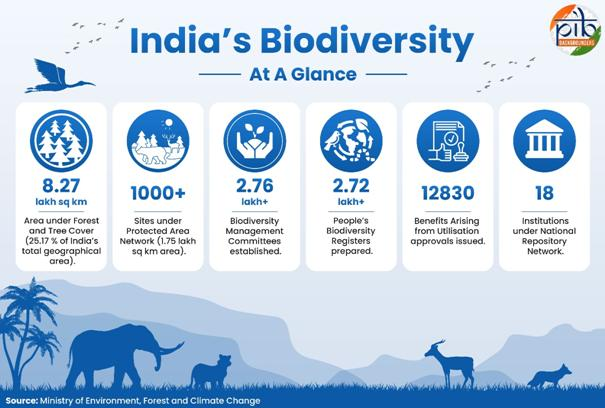
India’s Biodiversity Framework
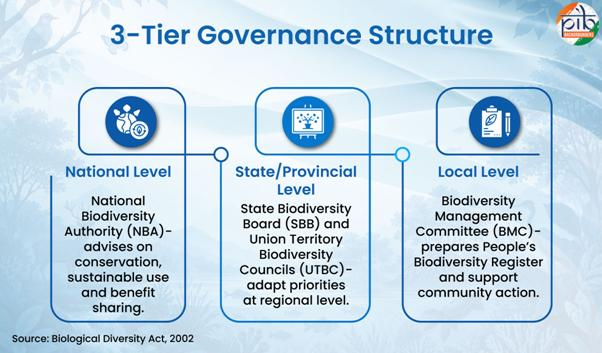
- The Biological Diversity Act ,2002 (Amended in 2023): It provides the statutory basis for biodiversity governance through institutions at the national, state, and local levels.
- The law also supports the documentation and protection of biological resources and associated traditional knowledge.
- The 2023 amendment further strengthened this framework by making implementation more facilitative and aligned with current needs.
- Section 39 of Biological Diversity Act, 2002: It empowers the Central Government to designate institutions as repositories for different categories of biological resources.
- Any person discovering a new taxon is required to notify the designated repository and deposit the corresponding voucher specimens.
- Scientific and technical support: The Zoological Survey of India (ZSI) and the Botanical Survey of India (BSI) document animal and plant diversity.
- The Forest Survey of India (FSI) maps forest and tree cover in periodic State of Forest Reports.
- The National Tiger Conservation Authority (NTCA) and state forest departments support the conservation of tigers and their habitat.
- National Biodiversity Authority Fund (NBAF) : It is a statutory fund that supports biodiversity governance by providing a mechanism for benefit sharing and conservation related use.
- People’s Biodiversity Register (PBR): It is a local biodiversity database prepared with community participation, the Biodiversity Management Committee prepares it in consultation with local people.
- PBR is an important tool for documentation, conservation, and benefit sharing.
- National Biodiversity Strategy and Action Plan (NBSAP 2024-2030): It provides India with a long term policy direction for conserving biodiversity and using it sustainably.
- The updated plan for 2024 to 2030 is aligned with the Kunming Montreal Global Biodiversity Framework (KMGBF), which gives it strong international relevance.
- National Red List Roadmap (2025-2030): It is led by Zoological Survey of India (ZSI) and Botanical Survey of India (BSI), with support from IUCN-India and the Centre for Species Survival, India, the roadmap will establish a nationally coordinated, science-based threatened-species assessment system.
- Biodiversity Finance India was launched in 2015 as a finance planning initiative to identify biodiversity funding needs and mobilise resources for conservation.
- It focuses on identifying and mobilising finance, while the NBAF channels resources through a statutory mechanism for conservation and benefit sharing.
International Frameworks for Biodiversity Conservation
- Convention on Biological Diversity (CBD), 1992: It was adopted at the Earth Summit in Rio de Janeiro. It is a Legally binding international treaty with near-universal membership. India is a party to CBD
- Intergovernmental Science-Policy Platform on Biodiversity and Ecosystem Services (IPBES): It was established in 2012 and often called the “IPCC for Biodiversity.”
- It provides scientific assessments on biodiversity and ecosystem services which supports evidence-based policymaking.
- Ramsar Convention (1971): It is an international treaty for the conservation and wise use of wetlands.
- Promotes designation and management of wetlands of international importance.
- Convention on the Conservation of Migratory Species of Wild Animals (Bonn Convention): It was signed in 1979 and conserves migratory terrestrial, marine, and avian species. It also encourages international cooperation along migratory routes.
- International Union for Conservation of Nature Initiatives: It maintains the globally recognized IUCN Red List of Threatened Species.
- It develops protected area categories and conservation guidelines.
- Nagoya Protocol: It is a legally binding supplementary agreement adopted during COP-10 of the Convention on Biological Diversity in Nagoya, Japan.
- It ensures the fair and equitable sharing of benefits arising from the utilization of genetic resources, as well as associated traditional knowledge held by indigenous and local communities.
- Kunming Montreal Global Biodiversity Framework (KMGBF): It was adopted during COP15 of the CBD in Montreal, Canada.
- It is an international agreement adopted in 2022 by 196 nations to halt and reverse biodiversity loss by 2030 and achieve a vision of “living in harmony with nature” by 2050.
- Includes the 30×30 Target: conserving at least 30% of the world’s land and oceans by 2030.
- Recently, MoEFCC has submitted India’s Seventh National Report (NR-7) to CBD, reaffirming its commitment to the objectives of the Convention.
Conclusion
- India’s biodiversity efforts are now rooted in a strong blend of laws, institutions and community‑led action, aligned with global frameworks under the CBD.
- India is strengthening forest and tree cover, expanding protected areas, improving species conservation and deepening local stewardship in a coordinated manner.
- Looking ahead, updated strategies, dedicated financing and transparent national reporting place biodiversity at the heart of sustainable and inclusive development.
Source: PIB
Previous article
Building a Farmer-Centric Agricultural Ecosystem
Next article
News In Short 06-06-2026
